

Your finances, trusted across every site.
Tired of scattered data, manual workarounds, and late accounts?
Get timely insights, control, and confidence to grow with hospitality accounting and payroll for mid- to large-sized businesses.
Trusted by over 40 clients across 320+ UK sites



YoY revenue growth for clients
Annual client turnover managed
Client retention rate
Services

Outsourced accounting teams
Your finance team, without the hiring headaches. We deliver accurate numbers in a timely manner.
Consolidated reporting across multi-entity groups.
Dedicated team of qualified accountants.
Month-end closed by day 8.
Cost similar or less than an in-house team, without the churn.
Tech-agnostic: keep your tools or switch with our help.

Multi-entity accounting software & setup
Hate your clunky accounting software but dread the switch? We’ll take care of your move to Xledger, the leading platform for multi-entity groups, set up right by Europe’s top hospitality Xledger partner.
Real-time multi-site reporting and consolidation.
Built-in 5-4-4 accounting and hierarchical structures.
Cloud access, so you can see your full business anywhere.
Open API integrations with EPOS, inventory, payroll, and more.
Training, support, and ongoing optimisation.

Fully managed BACS-approved payroll
Hospitality payroll done right, by people with 25+ years’ experience. We run secure, compliant payroll so your team gets paid accurately and on time.
Dedicated UK-based payroll team.
BACS-approved payments, pensions, HMRC liaison, and compliance.
Secure online portal for staff and operators.
Clear reconciliations and custom reporting.
Integrates with tronc, rota systems, Xledger, and other tools.
What our clients say
"ACCURISE ARE LEGENDS! Great service, dependable, happy to flex, very supportive."
"Accurise genuinely care about your business. They are always prepared to go the extra mile to get a job done."

"I feel able to fully trust the work that Accurise does, which is a rarity and means that management accounting is an area I just don't need to worry about. That is golden!"

“Best firm I have worked with—systems, people, and culture are all top notch.”

“Best firm I have worked with—systems, people, and culture are all top notch.”
Why choose Accurise?

Human
No chatbots or faceless support. You work with a UK-based accounting and payroll team who understand hospitality and get to know your business, which is why 96% of our clients stay with us long term.

Efficient
As the in-house finance team for over 40 hospitality brands, we know how to join up messy systems, fix what’s broken, and get you live quickly.

Reliable & accurate
Numbers you can trust, when you need them. We close month-end by day 8, with daily support and weekly updates so you’re never left guessing.

Built to grow
Multi-entity structures are part of everyday life here. Our systems handle complexity with ease, and our team grows alongside your business.

Backed by VIEW Group
As part of VIEW Group, one of the Nordics’ largest financial consultancies, we stay ahead of regulation, best practice, and new technology, so you don’t have to.

Danny Stone
Book a chat
Send us a message
Fill out the form and we’ll be in touch.
Read the latest finance takeaways

6 signs it's time to switch payroll provider
Hospitality operators rarely switch payroll when things run smoothly. Here are the six we hear most often, and what each one says about the gap between generic and hospitality-specific payroll.

We've worked in hospitality payroll since 1999, and when operators switch to us, they tend to give the same reasons. Here are the six we hear most often, and what each one says about the gap between generic and hospitality-specific payroll.
Reasons to switch your payroll
1. Our current payroll provider knows nothing about hospitality
Generic payroll providers aren’t set up for the volume and turnover that comes with hospitality: zero-hours staff, frequent starters and leavers, third-party Troncmaster services, and changing rules and regulations. And while they might be able to get up to speed, it’s a lot easier to have a bureau that specialises in hospitality, and does it every day.
Pensions is one of the areas we often correct during onboarding. Specific mistakes include accounts with the wrong tax relief applied or salary sacrifice schemes not set up or loaded correctly into the pension provider.
Another example is holiday pay. It's simple enough for salaried staff. But when rotas change week to week, pay needs to be averaged out, and that's exactly where mistakes can creep in.
2. We can't get payroll reporting by site
If you run a multi-site hospitality business, getting a single payroll total isn’t enough. Staff may work across different locations, so their costs need to be moved between sites. And you’ll likely want to see labour costs broken down by location so you can build accurate site-by-site P&Ls or compare one site against another.
If you can’t get payroll reporting by site, the workaround is often manually splitting numbers in spreadsheets after each pay run. The more sites you have, the longer it takes. Payroll should provide costs by site, department, and job title and handle these transfers for you.
3. The automation isn't working, so we check everything anyway
Payroll relies on automation for payment runs, HMRC submissions, and pension contributions. If any of that's set up wrong, it's hard to fix, especially with tech-first providers who don't have enough people on the phones.
This is where offers like "£20 a month and you can do it all yourself" don’t deliver. The software might be good, but someone still has to set it up and stay on top of things like new tax thresholds, minimum wage rates, and statutory payment rules. If the person setting it up doesn’t understand payroll, they may not notice problems until something goes wrong.
4. There's no one to call when something goes wrong
We hear this a lot, and it follows on from point 3. The systems might work well with external providers, but when something goes wrong there’s often no one to help. In-house payroll has the opposite problem: it runs well until the person in charge is off sick or leaves, and then there is no backup.
When you work with us, you get a dedicated UK-based payroll manager who knows your account. If HMRC comes to inspect, we’ll come to your site and support you through the process.
5. We’re going to need to charge extra for that
That "cheap" quote might not be cheap after all.
We saw this with a pub group client. Their rota software provider quoted them for payroll, with a headline price of about £1 per payslip. But the extra charges weren’t mentioned upfront: £5 for every starter, £7.50 for every P45 when someone left, and an extra fee to send a BACS payment.
We include everything in one fixed price per payslip. The only extra charges are for gender pay gap reports, ad hoc reports, P11Ds, and reruns if there’s a client error.
6. Staff haven't been paid, or they've been paid wrong
Everything above is frustrating and time-consuming, but nothing breaks staff trust faster than being paid late or paid wrong. In hospitality, where keeping staff is already tough, that’s usually when operators start looking for a new payroll provider.
Recognise any of these?
Talk to us or visit our hospitality payroll page.
We run parallel payrolls during the switch, so your people get paid correctly from day one.
Most operators can tell after just one call if we’re the right fit. And once they join us, they usually stay, with our clients averaging 10 years with us.

Xledger for hospitality: Why it’s the best multi-site finance system
Discover why Xledger is the go-to ERP for multi-site hospitality brands. Real-time reporting, multi-entity accounting, and smart workflows, plus insights from our clients Farmer J and Wingstop who’ve seen the benefits firsthand.
Running multiple sites or a complex group structure is hard enough. The last thing you need is accounting software that makes it harder.
We’ve worked with more than 40 hospitality brands across hundreds of sites. Every time, Xledger is our core ERP software. It’s built for businesses with multiple entities and a lot of moving parts, and that shows in how it handles group reporting, approvals, and accounting tasks.
Here's what sets Xledger apart, with input from two of our clients Farmer J and Wingstop.
Why multi-entity accounting sets Xledger apart
If you’re running one or two sites, Xero will do the job. But as soon as you grow to three or more sites, or have more than one company in your group, basic accounting software starts to show its limits.
That’s when most operators look at bigger ERPs like NetSuite, Sage Intacct, or SAP. Xledger sits in this space, but it stands out for its multi-entity features.
As Rob, our MD at Accurise, puts it: "There’s nothing that consolidates everything in one place as well as Xledger. We’re talking workflows, approvals, payment runs, accounting, balance sheets as if it were one company."
In practice, that means:
- Site managers see their own P&Ls.
- Area managers get reports for all their sites.
- Head office gets the full picture, broken down by site.
- Investors and shareholders see the figures that matter to them.
- All companies in the group are consolidated in real time.
Key features for multi-entity hospitality accounting
Live multi-entity reporting across all sites
Xledger pulls live data from every company and site in your group. You can set up complex structures, run group-level reports, and keep every entity organised, so everyone gets what they need.
Mike Thorne, CFO at Farmer J (19 sites and growing), says: "I can see everything from the top line all the way through to all our costs at the bottom line. That's my snapshot for reporting, and I can do anything I want with that."
Daily P&L insights for site managers
Managers can check their P&Ls and expenses every day, not just at month-end. That means fewer surprises and more ownership at site level.
Arik Rubens, Financial Controller at Wingstop (now with 91 UK sites), explains that Xledger gives managers real ownership of their P&L and expenses through its workflow and approvals: “[Managers] have the ability to view this on a daily basis and that's what we try and inspire our sites to do, and Xledger provides a really simple way of allowing that to happen.”
Simplified invoice approvals and payments
Supplier invoices can be processed, approved, and paid directly in Xledger, across multiple companies at the same time, without touching your bank separately.
Automated inter-company transactions
If you’ve got lots of companies or sites, things like recharges, payroll, VAT, and supplier payments can get messy. Xledger automates these jobs, cutting the manual work and the risk that comes with it.
Manual posting errors and inter-company transactions that won't reconcile are some of the most common red flags in multi-entity finance, and usually the first things we fix.
Restructure your business without the admin
If you need to add new locations, company changes, or restructure, you don't need to do it from scratch. Xledger's hierarchical setup means you edit accounts, workflows, users, or ledgers once, and changes are applied to every site or entity in that group. Less admin and manual updates mean fewer errors. Plus, reports are always up to date.
Approval workflows that reduce risk
Manual processes are where errors (and fraud) tend to creep in. Xledger’s approval workflows let you set invoice thresholds, so anything over a set amount is flagged for review, keeping people informed and helping you spot issues early.
At Farmer J, they use workflows instead of EDI and now have, in Mike’s words, “almost 100% comfort in terms of money that’s going out of the business.” Invoices are auto reconciled when they match, and anything over £5 that doesn’t is flagged for review.
Open API and integrations with Power BI, Acquire, and more
Once you collect data, you should be able to use it how you want. But some systems claim your data is yours, then charge extra to access it. Xledger offers a truly open API, so you can connect with tools like Power BI, Acquire, and ProcureWizard, and use your data as you like.
Mike from Farmer J says Xledger gives him full visibility and control: “If I want to access the data and build packs that are scalable, it’s all super easy. Again, it's that full transparency and control.”
Implementation matters as much as the software
Good software, set up badly, still causes problems.
At Accurise, we implement Xledger specifically for hospitality businesses. That means the right reporting packs, the right structures, and the workarounds that only come from working with 300+ hospitality sites. You get a system that's ready for how your business actually runs, not a standard setup you have to adapt yourself.
Want to see how Xledger could work for you? Talk to us or visit our hospitality software page.

10 hospitality finance red flags
When multi-entity finances slip, you might see late accounts, unreconciled intercompany balances, debit balances where credits should be, and cash in transit that never clears. Know the red flags and when to step in.

The most common warning signs that your hospitality finances are slipping into dangerous territory.
People rarely switch accountants when things run smoothly. And as the finance team for 40+ businesses with a combined annual turnover of over half a billion pounds, we’ve seen all kinds of finance red flags during onboarding.
Most new clients come to us needing a fix. These include late accounts, stressed teams, missing information, and handovers that reveal more problems than expected.
Here are some common red flags we see in hospitality finance. If any of this sounds familiar, it may be time to get help. You can always fix these issues, but the sooner you act, the better.
1. Debit balances on your creditors ledger
Your creditors ledger is a list of what you owe suppliers. Most of the time, those balances should be credits because you haven’t paid them yet.
If you start seeing debit balances, you might want to investigate. This often happens when payments are posted without matching invoices. The costs are hidden rather than recognised, making your profits look better than they really are.
A few small debit balances aren’t unusual if they’re recent and someone knows why they’re there and how they’ll be cleared.
Bigger issues show up when individual suppliers are in an overall debit position, or worse, when the whole creditors ledger is in debit. That means you’ve overpaid suppliers and need to get money back, or costs are missing and your profits aren’t accurate.
2. Late accounts
If monthly accounts take more than 8 days to arrive, that’s not ideal. But waiting months is a big problem. Late accounts make it hard to spot issues, control cash, or make good decisions because you’re always working with old information.
3. Large balances in your cash in transit accounts
Your cash in transit (CIT) account should only hold a couple of days of sales. Large balances suggest bank postings aren’t reconciled, or cash isn’t reaching the bank. Either way, transactions aren’t flowing properly, and the accounts can’t be relied on.
Here’s how it should work:
- Sales happen: Credit in sales, debit in CIT.
- Cash arrives at the bank a few days later: debit in the bank, credit in CIT.
- Reconcile: CIT clears once the entries match.
4. Deposits and gift cards in a debit balance
Deposits and gift cards should usually be credits, because customers pay you before they receive anything.
If they show as a debit balance, it often means the sale has been recorded twice. Once when the voucher or deposit was sold, and again when it was used. This is a common mistake in hospitality and makes sales look higher than they really are.
5. Big suspense account postings that hang around
A suspense account is where you put unknown transactions while you’re waiting to find out what they are.
It’s supposed to be a short-term placeholder. If large balances sit there for a long time, it usually means poor processes and increases the risk of mistakes or misuse.
6. Intercompany balances don’t reconcile
If you own two companies, money sent between them should match on both sides. For example, if Company A sends £100 to Company B:
- Company A should show a £100 debit with Company B.
- Company B should show a £100 credit with Company A.
All intercompany balances should equal zero. If they don’t, one company thinks it’s owed money while the other thinks it’s paid.
Balances that don’t reconcile usually happen in manual systems where journals aren’t automatically posted to both companies. Manual posting takes time and often leads to mistakes, which software like Xledger can avoid by handling intercompany postings automatically.
7. Accruals showing a debit balance
Accruals let you record expenses in the month they happen, even if you haven’t received the invoice yet. Usually, accruals have a credit balance because the expense is already in your P&L, and the accrual holds it until the invoice arrives. When the invoice comes in, it’s matched to the accrual, so your charges appear in the right period.
If you see a debit balance in the accrual, something isn’t right. It might be a prepayment entered by mistake, which isn’t a big issue, or it could mean an expense was recorded without an accrual, which is more serious. Either way, it should be checked.
During onboarding, we review your accruals and point out any issues to help keep your accounts accurate.
8. Prepayments that aren’t unwinding
Prepayments are the opposite of accruals. You pay first, then recognise the cost over time.
Take insurance as an example: one bill that covers the year ahead. You pay upfront, but the expense gets spread across the next 12 months. So, you hold it in a prepayments account and release a portion to the P&L each month.
But if prepayments aren’t unwound properly, costs stay on the balance sheet instead of being released to the P&L. That’s a problem because if the spent money never shows up as an expense on the P&L, profits look better than they really are.
9. Suppliers put you on stop
Being put on stop means suppliers refuse to deliver until they’re paid. If this happens unexpectedly, it’s often a sign that something isn’t working in accounts payable.
10. Running out of money without knowing why
And, this might be obvious, but if you’re dipping into personal funds without understanding why, your cash flow isn’t being tracked properly and needs immediate attention.
Any of these red flags sounding familiar?
We fix even the biggest finance messes, and after the first month-end we usually have your accounts running smoothly.
With an NPS score of 61 (125% above industry average), you’re in good hands.
Talk to us about:
- Outsourced accounting teams.
- Multi-entity accounting software & setup.
- Fully managed BACS-approved payroll.
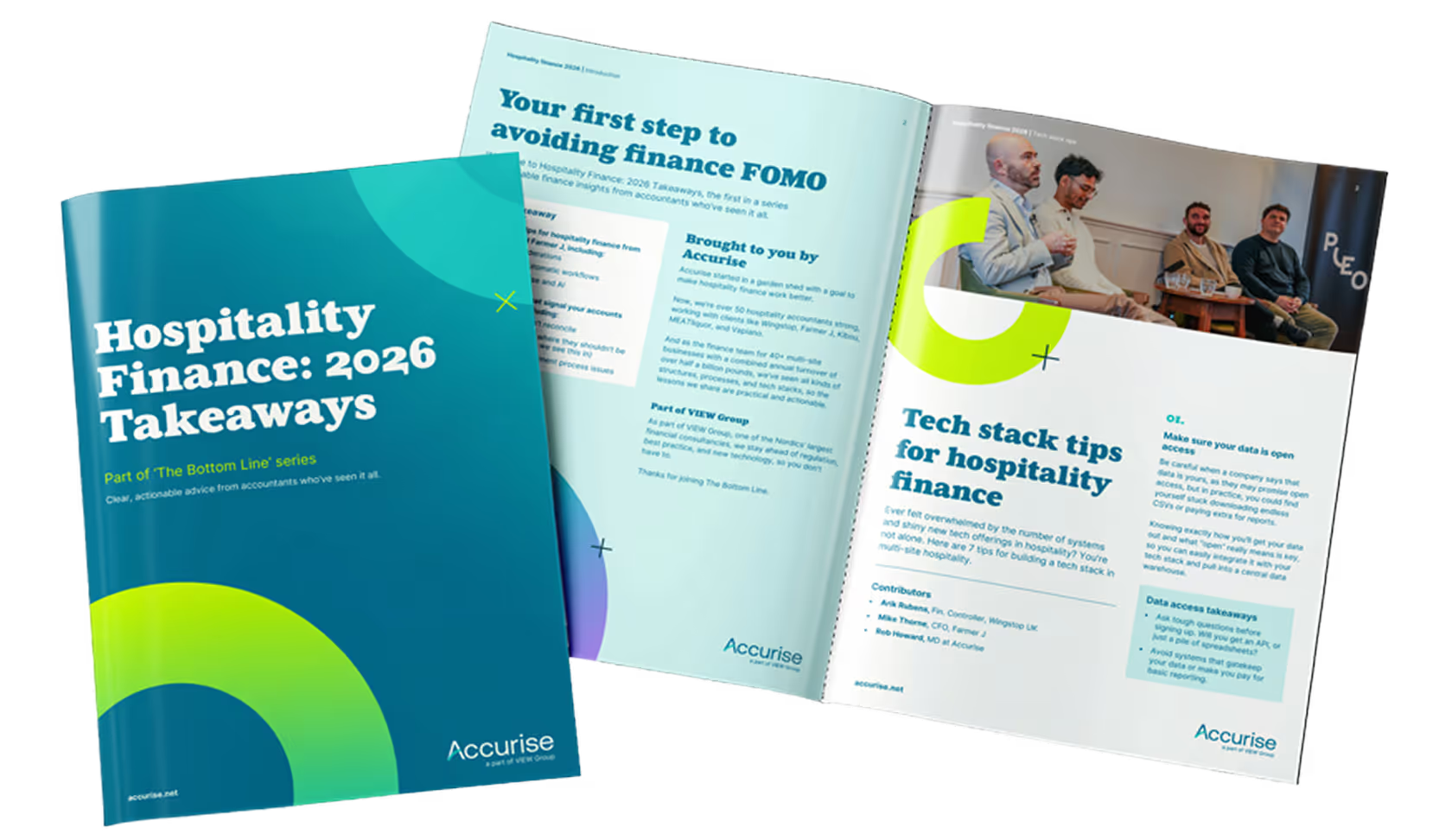
Free Hospitality Finance Takeaways 2026
How leading hospitality businesses structure finance teams and systems, with insights from Wingstop and Farmer J.
Get instant access below. You can also subscribe to The Bottom Line for monthly finance tips